By Amna Khwaja
‘There’s nothing to say that it’s against religion for women to play football. It’s not against our religion, and it’s not against our culture.’
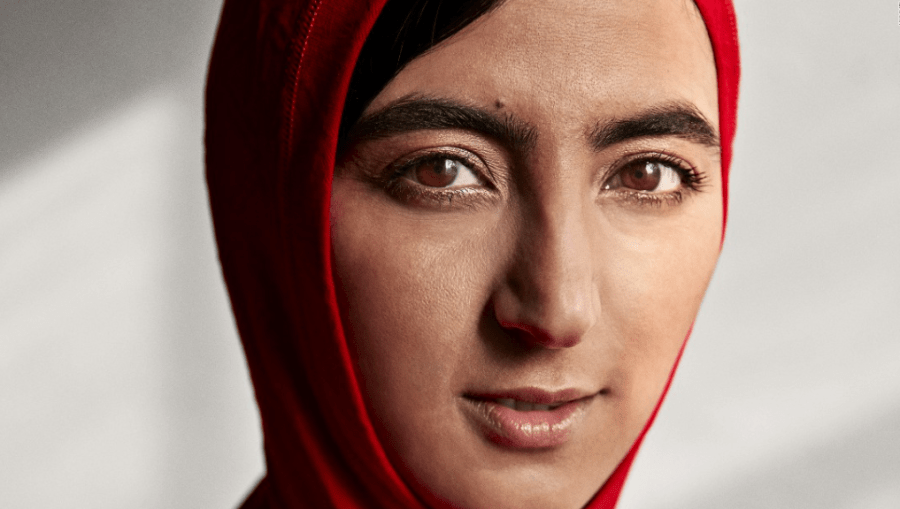
Dressed in the national football strip of Afghanistan, Khalida Popal is kicking a football for the photographer. Appearing at the Beyond Sport summit in London, she exudes a sense of the steely determination she has needed to survive after her teenage interest in the game put her life in danger, and changed the course of her future.
‘When I was teenager I started playing football,’ Khalida says. ‘It was 2004, I was sixteen,and we were just playing and having fun. The good thing about football is that you can bring as many people as you can find, and just kick the ball.’
Growing up in a middle-class family in Kabul, 29 yr old Khalida had a wider sense of possibility than many other Afghan girls. Her mother was a sports teacher, and the family placed no limitations on their daughters, encouraging them to do their best and blossom. But, of course, Khalida, was growing up in Afghanistan, and vividly remembers her total disbelief when the Taliban seized power and her father told her she wouldn’t be able to go to school any more. In 2004 the country was still reeling from the consequences of Taliban rule, and the American invasion after the 9/11 attacks. Although improving the rights of women had been cited by western politicians as part of the reason for the incursion, women remained second-class citizens, with muted voices, in many places living out a primitive existence.
On Khalida’s dusty school yard some of their country’s wider problems could be forgotten – but it wasn’t long before the girls had a cruel encounter with some men who attacked their playing field; hurling abuse, damaging their football, and running away with their bags. Football was a man’s game – and the women who played it were surely little more than prostitutes, they claimed. For Khalida the insults were made worse by the fact that she also often heard them from other women, the most marginalised people attacking themselves.
‘We were already wearing long skirts, long sleeves and tights, but these people were against women’s development and participation in society in general,’ Khalida says.
In a country where standing up for equal rights was usually unthinkable, Khalida was propelled to keep going – and go further: three years later, in 2007, spearheading the launch of the first national women’s football team. It was a hugely exciting development, but Khalida’s hardships continued.
When she became the first female employee of Afghanistan Football Federation, she found herself in an office surrounded by chauvinist men who were threatened by her presence and refused refused to collect their pay checks from her. Later they would come back, embarrassed, after Khalida insisted that she wouldn’t allow a man to act as an intermediary for her.
‘Some of my colleagues even didn’t want to be in the same office as me. When I entered the office, they left. They didn’t want to talk.’
As well-known members of Kabul society and government, however, Khalida’s family were still under grave threat and, fearing for their lives, Khalida and her parents soon departed for Pakistan where they spent eight years in a refugee camp. Starting over in such tough conditions was very difficult, but the one thing that sustained Khalida was football – something that she found she could pursue in Pakistan which already had women’s football teams. The Afghanistan women’s football team played its first international game on a Pakistani pitch – a proud if farcical moment, as Khalida explains:
‘It was first time that we played football on real grass, because in Afghanistan we only played in the dust. In our first game we were all falling down, and slipping everywhere. It was crazy. It was so funny.’
Although she returned to Afghanistan, Khalida was forced to go underground and flee once more after her football career put her in too much danger. Home now is Copenhagen where she has been granted political asylum and where, at long last, she has been joined by her parents. Although she admires Denmark greatly, and notes the contrast to women’s lives, Khalida says she is weary of a disrupted life that means constantly meeting new people, and making new friends, before being forced to uproot and move on once again.
‘At some point you’re tired of making any new networks. You are tired of making friends. You fear that once again you will have to leave, and you will lose them, and it will hurt you, and that will make you so lonely and depressed. This is war that gives us this ‘gift’: wars take so many things from people around the world. ‘
Although a knee injury means that she can no longer play herself, it is Khalida’s belief that the power of women keeps them striding forward. Since leaving Afghanistan, Khalida estimates that more than three thousand women are involved in playing football. American soccer player and coach Kelly Lindsey now manages the Afghanistan women’s team, and Khalida was involved in securing long-term sponsorship from Danish sportswear brand Hummel – as well as their unique design for a new kit with an inbuilt hijab.
“Women need self-confidence and they can gain that through sport,’ Khalida says ‘Then nobody can stop them. I believe in the power of women, they are strong.”
 thelondonsmog